Monday, January 08, 2007

You call that development?

In addition to being an excellent cook and a skillful earthen builder, Pun Pun resident Pi Ben also happens to be one of the foremost environmental justice activists in Thailand. Recently we have had occasion for discussion with Pi Ben about his work with a Thai grassroots organization called the Assembly of the Poor. What follows is my synopsis of our discussions with Pi Ben.

The Assembly of the Poor was formed about a dozen years ago to give a voice to people all over Thailand who were adversely effected by government policies pertaining to forestry, dam projects, industrialization and urban housing issues, etc. The Assemblies gathered several times in Bangkok for protests around the Parliament, the largest comprised of around 12,000 people and lasting 100 days.

These thousands of people peacefully self-organized to petition the government to address the problems that stem from the wave of economic globalization that has swept Asia for the past several decades. The Assemblies have made important gains, but have been frustrated as well by promises un-kept by the government. (In eleven years, Thailand’s government has changed five times; thus agreements made by one regime have seldom been respected by its replacement.)

Pi Ben talked to us about how one particular dam project (out of many hundreds) illustrates the wrong-headedness of so-called development policies imposed by agencies such as the World Bank and the Asian Development Bank.

The Pak-Mun Dam is located in northeastern Thailand near where the Mun River empties into the Mekong River, along the border between Thailand and Laos. To build this dam, the government borrowed 6,000 million Baht (about $200 million) from the World Bank.

The motivation to build the dam was to generate increased capacity for electricity to entice international financiers to invest in large-scale industrial projects in Thailand, and also to supply additional power to the rapidly growing population centers such as Bangkok. The dam is enormous – about 1 mile across and nearly 200 feet high. However, despite its size, it produces less electricity than is required to power one Bangkok skyscraper or shopping mall. But poor engineering design is the least of the problems associated with this dam project.

To understand a more complete picture of the devastation wrought in this attempt at “development,” it is instructive to examine the ecological and cultural conditions of northeastern Thailand prior to the undertaking of the project.

For centuries, northeastern Thailand (as in much of southeast Asia) had been sparsely populated by self-reliant, agrarian communities. These communities were, of course, poor by Western standards in that they had very little money. But this did not matter since there was very little use for money anyway. The people were rich in a more authentic sense – they had easy, enjoyable lives: a variety of food, adequate shelter, strong community and family bonds, and plenty of free time. Children and young adults were educated at home and in the village and also had the opportunity to attend school in the cities. Most returned to their villages after completing formal education.

One of the mainstays of the Thai villagers’ diet and culture was fish from the rivers of the northeast. Hundreds of varieties of fish traveled the expansive waterways each year between the mountains of interior Thailand and outlet of the Mekong River in the Gulf of China on the border of Cambodia and Vietnam. The fisherfolk of the northeast used baskets and nets made of bamboo to scoop fish out of the rivers along which their villages were situated. Pi Ben told us of the celebrations in and along the rivers during the rainy season when the fish were running upstream to spawn – so many boats, people laughing and playing. It was a social and cultural event – not simply a task undertaken in the procurement of nutritional sustenance.

The fishing villages traded their surplus of fish with the forest villages for wild boar meat and other forest products, and in local markets for vegetables, crafts, supplies, etc. For the most part, everyone was happy and everyone had enough; however, all this changed when the Pak-Mun Dam was put in.

Hundreds of tributaries flow from all over northeastern Thailand into the Mun River. The Mun, in turn, empties into the Mekong, which connects to the sea and provides a corridor for fish and other aquatic life to travel over hundreds of miles. The Pak-Mun Dam, on the Mun River near its junction with the Mekong, blocks this corridor and has exterminated the fish runs and extirpated the human settlements dependent upon them.

Through the period of planning and construction of the dam, Thailand was ruled by a secretive military government. As a result, no information about the project was revealed in advance; as the watershed began to fill villages and fields were flooded and the inhabitants simply had to move. Little or no compensation has been awarded to villagers for their losses.

The villagers had little need for money before the dam went in. After the dam, they had to sell whatever they could of their possessions, including livestock, and seek paid work. The government’s solution for a small fraction of the fisherfolk was to hire them to work in fish farms. So now the people had to work for money to get fish whereas before they caught them for free. Worse, the farmed fish are less nutritious than the wild fish, their farming results in water pollution, and many types of farmed fish are genetically modified and patented by biotech corporations.

Most of the villagers were forced to move to the cities to look for work there. Many of the men traveled far from home and family to work as a laborer or taxi driver in Bangkok. Many of the women went to the brothels. Now the villages are lonely places since only the old people and the very young stay there – the adults have all had to move to the cities to find paid work.

So, in summation, here are the results of “development” as conceived by powerful Western institutions such as the World Bank:

An entire way of life for millions of people has been completely shut down by this (and similar) dam projects. And not just any way of life, but one proven to be successful and sustainable by centuries of co-evolution between people and the ecosystems they depend on.

A thriving traditional culture has been extirpated in favor of a short-sighted and narrow conception of “modernity.” Today, a museum near the foot of the dam houses the bamboo nets and baskets once used so widely for fishing in the rivers.

What’s more, this was all done completely anti-democratically – the villagers were never so much as asked if they’d prefer to go on with their “quaint” and “backwards” lifestyle rather than “get with the times” and get a job in the city like everyone else.

In their traditional lives, the villagers used little if any electricity. Cities such as Bangkok, however, use massive amounts of electricity; and it was for cities’ benefit that the dam project was undertaken. The irony is that the dam project itself, and hundreds of others like it, have driven thousands or even millions of people into the cities, thereby further increasing cities’ demands for energy.

Before the dam, the villagers had no money but lived very well in strong communities and enjoyed healthy environments. After the dam, the transplanted villagers became vitally dependent on money yet could never make enough, and were forced to live in urban slums that are polluted and dangerous.

Before the dam, villagers “worked” little – “work” was more like play, and in any case didn’t take up a great portion of the day, week and year. After the dam, the transplanted villagers “worked” many hours per day, most days per week, and most weeks per year, although now the “work” was more like slavery (as especially in the case of the women in the brothels).

“Working” prior to the dam provided not only for the villagers’ needs but a surplus as well. “Working” after the dam always left the people coming up short, since they must pay for food, shelter and transport, and wages were depressed by all the competition for city jobs.

Since the dam project was financed by the World Bank, Thailand as a nation is now (further) indebted to the Bank and this is used as additional leverage to expose Thailand and its resources to increased exploitation by international capital.

The non-human river ecosystems of northeastern Thailand (as well as Laos, Cambodia and Vietnam) have been inestimably molested such that they may never recover to their status before the dam was erected.

And all of this for less power than is required to run one Bangkok skyscraper.

(See also the International River Network's page on the Pak Mun Dam.)

Life is so good at Pun Pun

Charcoal kiln

I have undertaken to build for Pun Pun an aethetic and efficient system for the production of charcoal and wood vinegar. (Please see my previous post on charcoal and wood vinegar.)

The stongest motivation for this project is to be able to produce sufficient quantities of charcoal of good quality that can be ground up into granular carbon and used in a drinking water purification system I am designing.

Currently we drink rainwater, graciously purified by the hydrologic cycle. However, Thailand suffers an extended dry season and often rainwater supplies run out and the farm resorts to purchasing drinking water from the village. I will design a sand and carbon filtration system that will allow the community to drink water from the irrigation canals. This water has been tested and shown to contain small quantities of microorganisms as well as pesticide and fertilizer runoff from the nearby fields. A well-designed sand and carbon filtration system should remove these contaminants.

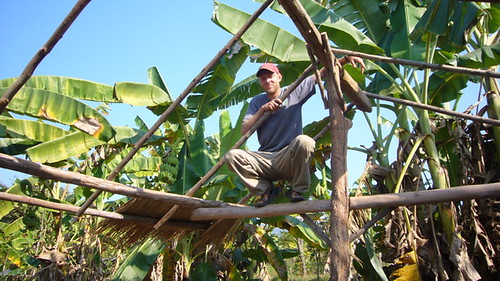
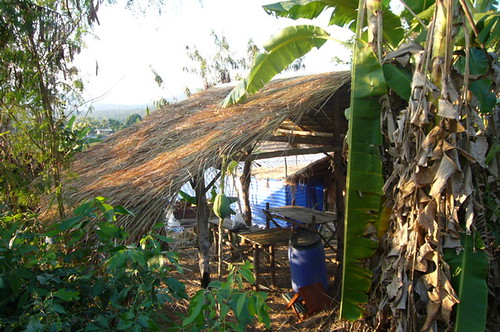
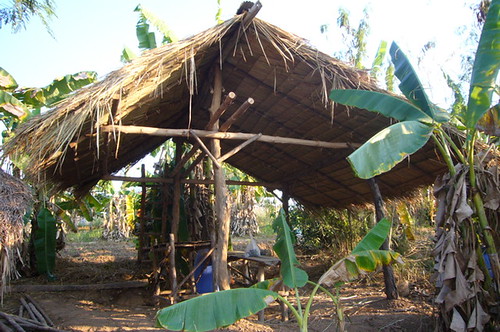
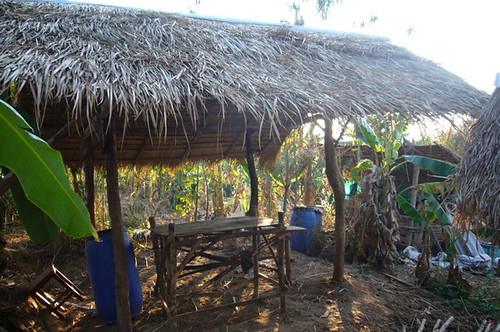
The first step has been to construct a shelter for the kiln. Here I've set up a timber frame just uphill from the kitchen.

Locating the kiln near the kitchen evinces the permaculture principle of locating often-used features near often-occupied areas. Stoking the kiln fire takes some babysitting for the first 1 - 2 hours; this can be done around meal times when the kitchen is heavily occupied. Also, the product -- charcoal -- will be used as a cooking fuel (in addition to it application to water purification); the shelter design thus includes a storage space for the chracoal.

The design will also include a bin for storing firewood to be pyrolized in the kiln and for stoking the fire. This bin will be on the south face of the structure to promote maximal insolation -- this will help with the drying of the wood prior to use.

Fixin' to get my thatch on...


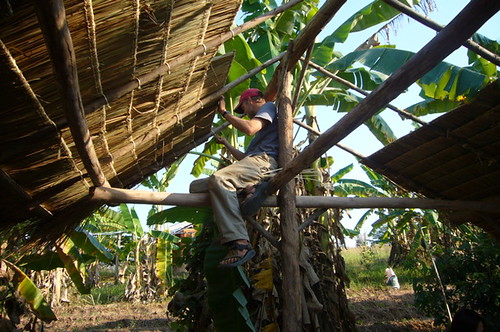
Thatch monkey, that funky monkey...

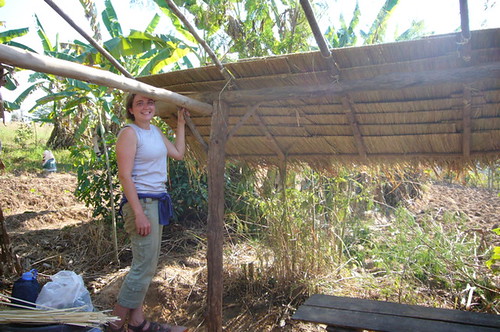
Couldn't have done it without Leah...

Finished thatch roof...


Pi Dtai and Pi Jeni taught us the old school way to thatch a roof -- with tie strips cut from fresh bamboo. To make these, you get a big, sharp knife and a long shank of bamboo. You cut the bamboo in half lengthwise, then keep cutting by half until you get very thin strips that can be twisted around the thatch panels and rafters to hold down the roof.

I tried to cut some strips myself, but I was very slow and I kept cutting myself both with the knife and the bamboo! I decided with the thumb incident I had bled enough for one week and so I asked Pi Jeni to cut all the stips for me. He is like some kind of bamboo slicin' ninja. He turns out perfect strips so quickly, and never cuts himself. Amazing! Turns out, none of the bamboo houses in his village use a single nail in their construction -- they are completely tied together with bamboo strips. So he's got some experience making these things...

Seriously folks, fresh cut bamboo is some sharp stuff. Pi Dtai said that back in the day when a woman gave birth they would use a piece of fresh cut bamboo to cut the umbilical cord.

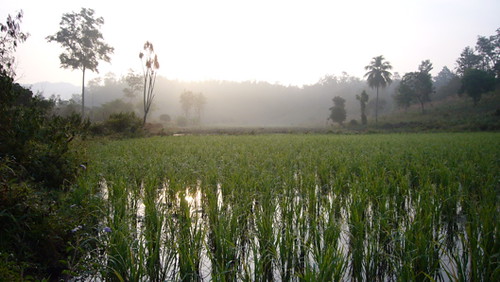
Sunrise over the rice fields

Yoga center

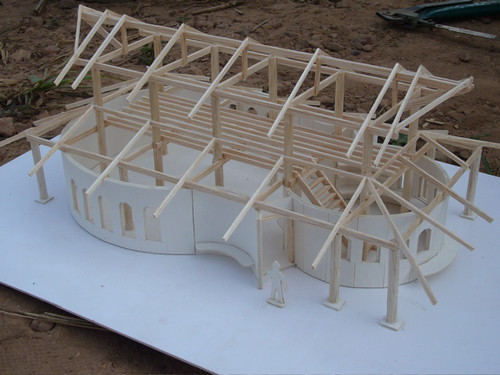
We have begun building the yoga center. This will be a two-storey, adobe and timber framed structure. Here's Pi Dtai's model:


We will build only the foremost one-third of the structure this winter (the round bit). The larger area will be for yoga, meetings, etc. The front room will be a cafe, library, reading room, meditation loft, etc.

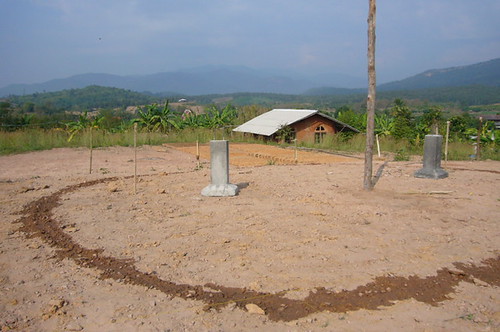
The view from the site

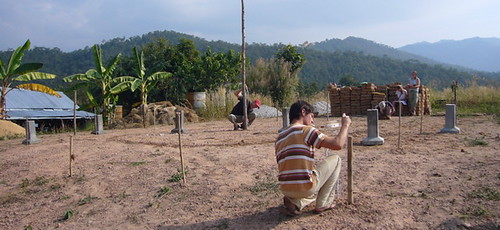
Brant and I using a water level to prepare the foundation

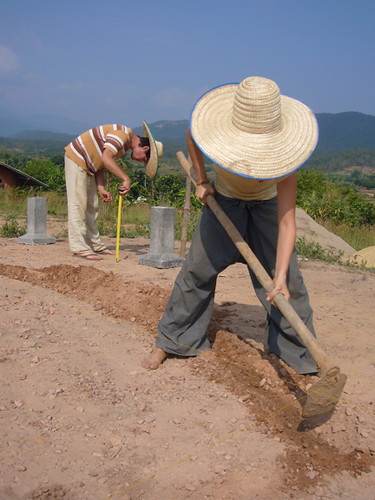
Brant measures for burying the footings while Amanda hoes out the trench for the poured concrete foundation

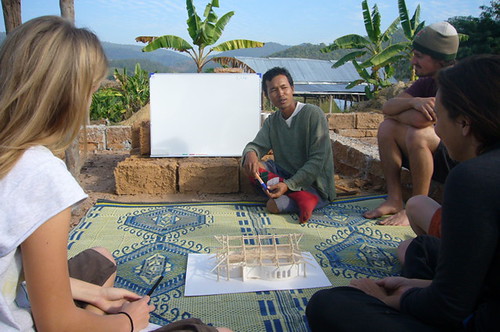
Pi Dtai lectures on Buddhist philosophy and how we can engage it in the creation of our building

Holiday adventures

The holiday season was nothing if not festive in our farming village in northern Thailand! Here are some photos that only hint at the fun...

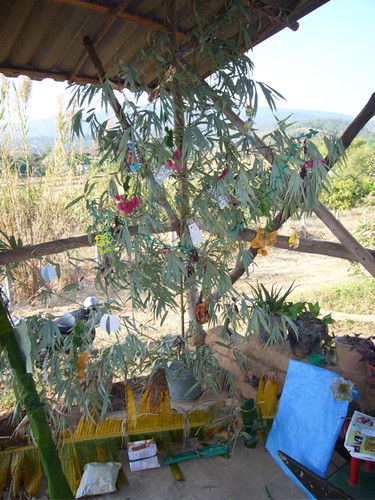
Our bamboo Christmas tree

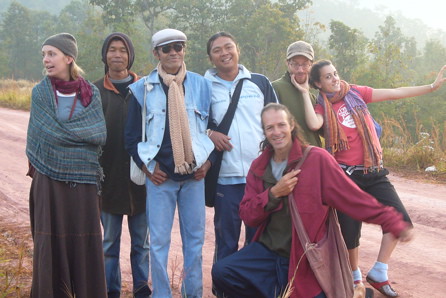
A cold early morning hike up to the Lahu hill tribe village, says Aussie Leah

If you lived in a hill tribe, and these freaks showed up for breakfast, what would you do?

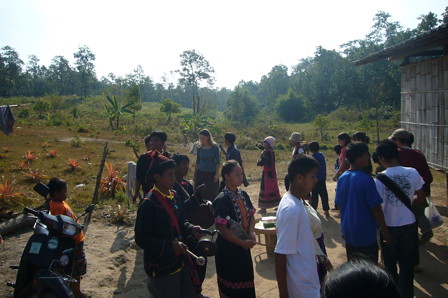
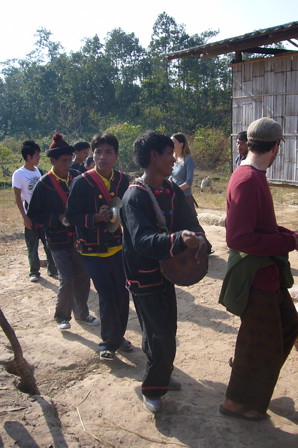
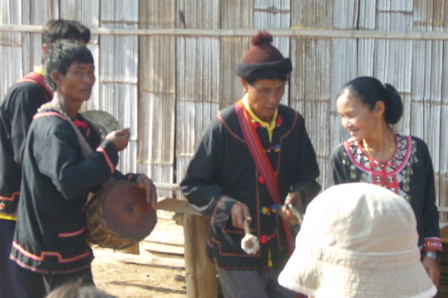
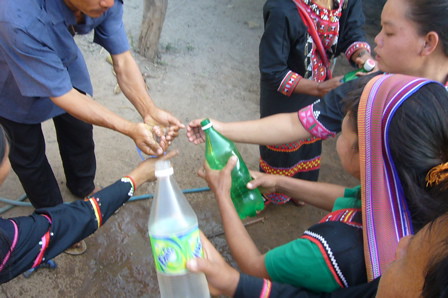
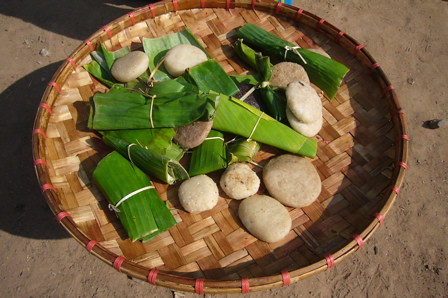
Celebrating with the Lahu hill tribe:
We danced in a circle at each villager's house


Then the dancers poured water over the host's hands

The dancers leave a tray of snacks for the host. The host takes then and gives other snacks to the dancers, who take them to the next house.

This chick was so into me...

Jun Jiao, Pun Pun's youngest member, dressed up in her hill tribe garb

New Year's Oddities...
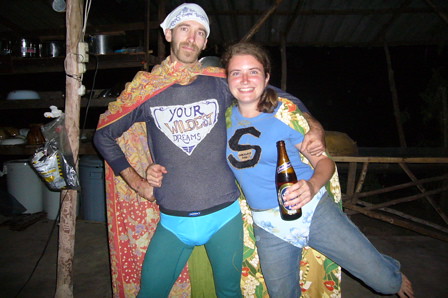
Baan Thai founder Christian and US Leah wear their undies on the outside

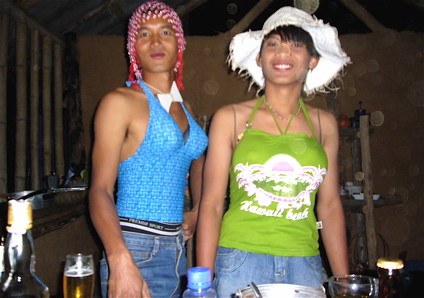
So, it was a costume party, but Pi Dtai and Dtang somehow got the idea it was a drag queen party. Aren't they beautiful?

OK, let me explain...

I'm representing the Gillian Welch song "Red Clay Halo"...

All the girls wanna dance with the boys from the city
and they don't care to dance with me
But it ain't my fault that the fields are muddy
and the red clay stains my feet

Well it's under my nails, and it's under my collar
and it shows on my Sunday clothes
I do my best with the soap and water
but the damned old dirt won't go

But when I pass through the pearly gates
will my gown be gold instead?
Or just a red clay robe, with red clay wings
and a red clay halo for my head?

Wednesday, January 03, 2007

Compost 101

My colleague Julia was kind enough to provide these detailed notes on professional compost making...

Hi everyone! On Josh’s latest adventure riding to Burma and back, he missed an exciting day of Compost 101 back at the farm. He asked me, Julia, a comrade in permaculture solidarity and a fellow intern who happened to have a notebook handy on the aforementioned day, to update you folks back home on the ins and outs of compost at Pun Pun. Here it goes…

Jo introduced the first composting technique, something he has practiced on the infertile soils of Pun Pun over the past 3 years and before that as well, on larger scale rice paddies and cornfields in other parts of Thailand. It is called Bocashi (which is perhaps a misspelling)! Originally, people began mixing animal manures and chopped dry leaves or organic matter, which they would cover with straw. They noticed that it decomposed quickly this way and so the Bocashi formula continued to evolve with additions of rice husks, ashes and beloved EM (efficient microorganisms) to more exacting specificities. The compost we made consisted of 2 parts rice husks (short grass clippings or chopped leaves could also be used), 1 part cow manure (or chicken manure), 2 parts ash (we used the ashes from our cook stove), and a water/EM solution mixed 20 parts water to 1 part EM. Jo mentioned that raw food scraps could also be added if so desired and after 27 days (exactly!) would be reduced to rich black soil. We blended the dry ingredients first, hoeing them back and forth until they were fairly well integrated, and then added watering cans full of water and EM until we could form a fist-sized ball that wouldn’t crumble and that wouldn’t drip when squeezed. Once we achieved the right consistency, we spread the compost on a concrete floor (if making on the ground, it is apparently a good idea to water the site first so that the compost doesn’t lose too much moisture). We then covered it completely with large plastic bags and let it sit. It will do its thing for about a week, or until the internal temperature cools down. Once it is ready, it can be spread out over garden beds and covered with a thin layer of dirt and planted into without any further tilling. Jo mentioned that, if applied to the ground once a year for two years, you will have soil so rich by the third year that you won’t have to fertilize it again. He actually had problems in the past with overly-lush rice paddies that he had to thin out: thus is the power of Bocashi!!!

Another tip that Jo gave for fertilizing larger areas of land is to cut all long grasses growing on them (or use straw), and leave them over the soil to trap in the moisture and bacteria in the soil. He also found that banana trees have an amazing ability to hold moisture in the soil in the area surrounding them. He and Peggy have planted all other fruit trees on the property inside clumps of banana trees so that they will flourish. Their experience has been that unless they do so, their fruit trees die or won’t produce fruit!

We learned a second compost technique from Leah, our awesome aussie at Pun Pun. She recently took a permaculture course at Baan Thai where she learned this technique. It is a bit of an everything-in-the-pot method using chopped grass clippings, rice husks, manure, food scraps and enough water for it to start running out the bottom. The basic rule of thumb is to mix 1/3 parts manure to 2/3 parts dry matter, and to not use too many rice husks (although they are cheap and easy here in Thailand and hand-chopping straw can get a bit tedious). The other hard and fast rule is to have a sizable bulk of a pile, not smaller than 1 meter wide and not larger than 3 meters wide. About a meter high is ideal. After mixing all of the above, an activator is needed to start the beautiful decomposition process. Urine, comfrey, yarrow, nettles, fish, animals (dead), or old compost will all work as activators. The advantage of this method is that it produces quick results, 18 days til perfection, but on the downside, it requires a bit of leg-work. Every few days it needs to be physically turned, or flip-flopped to a spot next to it. The first turning should ideally happen on the 4th day, followed by one on the 6th (plus a squeeze test to determine if there is enough water: one drip of liquid is good, 2 drips mean an addition of carbon material is needed). Then day 10, 12, 14, 16 and finally day 18 need turnings. Another thing to keep in the back of your head when creating the mix that goes into the pile is that you ideally want a mix of 30 parts nitrogen to 1 part carbon. This requires a bit of estimating on your part, but some helpful ratios to know are: fish are 7:1, urine 1:1, cow/horse manure 18:1, chicken manure12:1, green weeds 25:1, straw 50:1, paper 250:1, and food scraps 25:1. So far Abooey, our compost pile (named by Than), is cranking right along and smelling a bit strongly (probably a product of not having the proper ratio of nitrogen to carbon). We will update with the results of our 18-Day Wonder in a week or two, along with distribution guidelines.

Hopefully this is enough to get you started in your composting adventures, or enough to satiate your curiosity about the goings-on at Pun Pun on this particular day! We continue to plant seeds, water our fledgling gardens, make bricks, work on the foundation of our building, make amazing food (including pizza) in our newly finished stove and oven, talk, dance, drink EM cocktails, sing badly around campfires, get daily doses of wisdom from our mentors, and miss everyone back home… happy new year!

L'Oven unveiled


The adobe oven is complete. Check out that decorative detail work!