My internship has begun at Pun Pun (means “thousand varieties”) farm in northern Thailand. We are about 35 miles north of Chiang Mai city in a small farming village called Baan Mae Jo. It’s beautiful here – much calmer, quieter and cleaner than Chiang Mai.
Pun Pun is an organic farm and seed bank that began a little more than three years ago. It was started by Jo Jandai, a Thai from the northeastern part of the country, and Peggy Reents, originally from Colorado. Peggy and Jo are married and have a two-year-old son, Tahn, who is already an energetic adobe builder.
Jo has more than ten years’ experience in earthen building (adobe, cob, wattle and daub, etc.) but is most passionate about Pun Pun’s seed saving activities. Peggy and Jo have traveled all over Thailand doing building projects, have held many workshops here at Pun Pun, and have helped numerous friends and neighbors with their projects. During the internship we will be building a yoga and meditation center primarily out of adobe, but using an array of earthen and natural building techniques as well.
Besides Peggy and Jo (and Tahn!), there are about eight full-time community members (mostly Thais) and about an equal number of long-term guests (a mix of Thais and Westerners). This group includes myself and my colleagues, a total of five winter interns. Many guests and visitors regularly come and go, including people from the village.
Since Pun Pun’s establishment, two neighboring communities have sprung up working on similar activities. One is, for the time being, called Baan Thai (“Thai House”), which is a group of about twelve North Americans organized by a previous Pun Pun intern to create a kind of permaculture laboratory on about ten acres of land adjacent to Pun Pun. The other is called You Sabai (“To relax and feel healthy”) and is run by a Thai couple who are writers and are working to publish a “lifestyle” magazine profiling sustainable living. They adapted some Pun Pun building techniques to create a very comfortable coffee shop at the top of the hill overlooking the other farms, and are planning to host retreat groups for Thai massage, meditation, etc.
Building workshops have provided the income for Pun Pun, as well as most of the structures on the farm, although building is not the main focus of Pun Pun as an organization. Currently, our planet is experiencing the largest mass extinction of species in its history (including the period after the asteroid impact in Mexico that killed off the dinosaurs). The rate of species dieoff seems to be accelerating, as the Living Planet Index shows about a 30% drop in the number of vertebrate species since 1970. Recognizing this precipitous decline in biodiversity, Pun Pun’s principle mission has been to create a seed center to collect rare, indigenous and beneficial seeds from around the region and world, propagate them at the farm, and share them through a network of farmers in Thailand, and in this way counter some of the destructive trends of biodiversity loss in food crops. Pun Pun has thus become an active learning center that hosts workshops, internships and trainings on sustainable living practices. Westerners pay tuition to attend these programs, which allows Thais and people from other developing countries to attend for free.
The success in farming that Pun Pun exhibits after only three years is a testament to the efficacy of permaculture methods. Before Peggy and Jo bought the land it had been forest which was clear cut to plant a few crops of corn. Tropical soils in general are very depleted in nutrients, and so only a very few harvests of corn could be obtained and then the land was nearly dead and thorny grasses took over. The people of the Baan Mae Jo village though Peggy and Jo were crazy for buying this land and trying to farm here: it’s a hilly site with sandy soil and many rocks -- it sold cheap since the owner believed it was nearly worthless for farming.
Immediately Peggy, Jo and a few friends began planting several varieties of banana trees, which grow easily and rapidly in these conditions and produce a good mulch of banana leaves that add nutrition to the soil. Skillful organic gardening since the beginning has produced a wide variety of edible plants that, including rice from Pun Pun’s paddy area, comprise about half of all food eaten by the community. Part of my internship is concerned with establishing some new garden beds as well as attending existing gardens; I will provide subsequent detailed posts describing this work and all the amazing and delicious foods that are growing here.
Wednesday, December 13, 2006


Friday, December 08, 2006
Let's play a game
Let’s play a game called “What have I got in my rucksack?”
Well, it’s not much of a game really since I am going to tell you the answer. Now, I could go through the whole list:
three short-sleeved cotton t-shirts
two long-sleeved thermal shits
two pairs of Carhartt dungarees
one pair of hiking shorts
three pairs of wool-synthetic blend socks
three pairs of boxer shorts
first aid kit
headlamp
two toothbrushes and one tube of toothpaste, soap and shampoo
malaria and diarrhea medication
laptop computer and associated hardware
one pair of Chaco sandals, one pair of sturdy hiking/working shoes
one Nalgene 1 L water bottle and iodine tablets for purification
one rain jacket
one Leatherman multi-tool
and so on…
But that’s all very mundane, and what I really want to get to are the books I have brought along with me and acquired since arriving in Thailand.
I should mention at the outset that I am well acquainted with the first and second cardinal rules of backpacking, which specify that one ought to minimize both the number of articles in one’s pack as well as the weight of things being carried, and that carrying around a selection of several books tends to run one afoul of both of these rules. But for the past few years I have contracted a case of chronic book acquisition syndrome and it would be presumptuous to expect that an extended journey around Southeast Asia would produce an immediate cure for this condition.
So let’s begin our game of “What books am I lugging around in my rucksack?”
The first two books, and I mention them first to get them out of the way, for I doubt that they truly count against the total tally in this game, are from the Lonely Planet series and they are a guide to Thailand as well as a Thai phrasebook.
The phrasebook is small enough to fit comfortably in the front pocket of my Carhartt dungarees, and owing to this physical characteristic of the book I assumed, wrongly, that its contents would be readily mastered on the plane ride from San Francisco to Asia. It turns out that Thai is a very difficult language, especially for Westerners, not least because it is tonal in nature. This means that there are about six different meanings for any one given word based upon how it is spoken -- with an up or down inflection, an accent here or there, and other such subtle differences. Thus far I have nearly mastered all of two phrases: “Sa wat dii, KAP” which means “Hello (I am a man)”, and, “kap kun KAP” which means “Thank you (I am a man).” The “KAP” at the end of the phrases is the part signifying my masculinity. If I were a woman, I would substitute “KAA.” I’m not sure why it is important to continually assert one’s gender during the course of a common conversation, but I am a guest in a foreign land so I play along respectfully.
With the requisite Lonely Planet guides out of the way, I will give 5 Baht (about $0.15) to the first person who can guess one of the books in my traveling collection.
Congratulations! Of course I brought my haggard and dog-eared copy of Zen and the Art of Motorcycle Maintenance by Robert Pirsig. A 5 Baht bonus will be awarded if you guessed that I brought along the sequel to this book, entitled Lila, as well. If I get through ZAMM before New Year’s that makes for six times (I think) that I have read that book this year. It may be the most important book ever. I’m not sure about this, but all the same you should run out to your local used bookstore and buy a copy right now and read it, over and over again if necessary, until you have sufficiently absorbed its messages. I predict that it will either cause a complete revolution in your life and the way you think about yourself and the world, or you will get a little way into it and decide “hey, this guy’s really mean to his kid, and he’s kind of an asshole to his friends as well”, and you’ll put the book aside and maybe forget about it completely. Then one day, someone in your life, probably me, will bring it up and say, “have you read Zen and the Art…” and you will say, “Oh yeah, I think I read that, maybe in college or high school, I forget, wasn’t he really mean to his son or something?” and I will sigh and suggest you revisit it. And then maybe the whole process will begin again.
Enough! On with the game. I can’t spend that much writing about one book, important a book though it is.
What to mention next? OK, how about E. M. Forster’s A Passage to India. I don’t know anything about this one -- it was given to me by my good friend Mary the night before I left for Asia. It looks interesting, and I am eventually going to India so maybe it has some important stuff I’ll need to know before I get there.
Next is a volume from the German Library Series of two of Herman Hesse’s stories: Siddhartha, and Demian. I read all of Siddhartha on the plane from Taipei to Bangkok and it blew my mind. I always read myself into books, but this one was really about me, man! Really! This is another one to run out and buy right away. Maybe it’s about you too. Or maybe not, but if you read it you might understand me better. (I’m sure that understanding me is a very high priority for most of you since I am such an important person in all of your lives.) I finished Demian last night and it was very good as well.
The next book represents a very high mountain to scale indeed: James Joyce’s A Portrait of the Artist as a Young Man. I really want to get Joyce; perhaps I am asking too much of myself. I remember in college when I was taking an advanced physics course on subatomic particles and the professor told us that the name “quarks” came from a James Joyce novel, Finnegan’s Wake. So of course I ran right out and bought it, read the first three pages, closed the book and put it on my bookshelf and there it has remained since.
Next (this is beginning to seem crazy isn’t it? To carry all these books around! Well, wait, it gets better. We still haven’t finished the books I brought with me. After that come the books I have bought since I arrived…)
Next is The Unsettling of America by Wendell Berry. I am very excited to read this, since I’ve read many of Berry’s essays and he is my hero. I’m getting more and more into this farming thing, and here we have a brilliant farmer, philosopher, essayist and poet, and fellow Appalachian to boot! What could be better?
And finally, of the books I brought with me from California, well, it’s a section of a book really, photocopied. This one was hard bound and I only wanted certain parts so I managed to make copies just before I left. The excerpts are from a biography of Werner Erhard by William Bartley III. Werner Erhard, nee Jack Rosenberg, is the guy who invented est, the controversial philosophical training seminar that began in San Francisco in the 1970’s. The current form of est still going on is called the Landmark Forum, of which I took two courses this year. I’m still trying to work out just what the hell happened to me in the Landmark forum, and Bartley’s biography of Erhard goes lengths to expound upon the philosophy that underlies est and Landmark. Landmark is kind of like a course in practical Existentialism, and also draws heavily on Zen Buddhism. I know people think Landmark is creepy or cultish, but it really helped me and is continuing to do so, so I am very keen to understand just how it works and to develop a practice of my own for increasingly being “powerfully engaged with reality,” as they say.
OK, now on to the books that I have added to my traveling collection since I arrived in Thailand. (One thing about touristy Chiang Mai is that there are a bunch of great used bookshops, because truly clever backpackers, unlike me, tend to unload books rather than accumulate them.)
In keeping with my burgeoning interest in Existentialism, I picked up a copy of Sartre’s Nausea. I’ve started it, but I’m not sure if I will like it, or even get it. I know Sartre’s the apotheosis of Existentialism and if I ever want to call myself an Existentialist I have to get him, but I don’t know if I can groove on Nausea. (Hey, did anyone get that joke about “calling myself an Existentialist”? What could be more un-Existentialist than to shoehorn one’s self, whatever that is, into some reductionist conceptual pigeonhole?) Anyway, maybe I’ll end up doing an end-run around Sartre and go right back to Nietzsche and Kierkegaard and Dostoevsky and figure it out myself, eminent French philosophers aside.
OK, two more and we’re done. At least until the bookshops open tomorrow morning.
Nope, I lied, I see there are three more.
One: A history of Western philosophy by Bertrand Russell entitled The Wisdom of the West.
Two: A collection of lectures by Buddhist scholar Alan Watts entitled Buddhism: The Religion of No-Religion.
Three: Being Peace, a collection of essays by the Vietnamese Buddhist monk Thich Nhat Hahn.
Well, that’s it. Apparently I’m interested in philosophy. In fact this is so. This winter, to the extent that I am anything, I am a farmer and a philosopher. I know very, very little about either farming or philosophy. I am here to learn.
Well, it’s not much of a game really since I am going to tell you the answer. Now, I could go through the whole list:
three short-sleeved cotton t-shirts
two long-sleeved thermal shits
two pairs of Carhartt dungarees
one pair of hiking shorts
three pairs of wool-synthetic blend socks
three pairs of boxer shorts
first aid kit
headlamp
two toothbrushes and one tube of toothpaste, soap and shampoo
malaria and diarrhea medication
laptop computer and associated hardware
one pair of Chaco sandals, one pair of sturdy hiking/working shoes
one Nalgene 1 L water bottle and iodine tablets for purification
one rain jacket
one Leatherman multi-tool
and so on…
But that’s all very mundane, and what I really want to get to are the books I have brought along with me and acquired since arriving in Thailand.
I should mention at the outset that I am well acquainted with the first and second cardinal rules of backpacking, which specify that one ought to minimize both the number of articles in one’s pack as well as the weight of things being carried, and that carrying around a selection of several books tends to run one afoul of both of these rules. But for the past few years I have contracted a case of chronic book acquisition syndrome and it would be presumptuous to expect that an extended journey around Southeast Asia would produce an immediate cure for this condition.
So let’s begin our game of “What books am I lugging around in my rucksack?”
The first two books, and I mention them first to get them out of the way, for I doubt that they truly count against the total tally in this game, are from the Lonely Planet series and they are a guide to Thailand as well as a Thai phrasebook.
The phrasebook is small enough to fit comfortably in the front pocket of my Carhartt dungarees, and owing to this physical characteristic of the book I assumed, wrongly, that its contents would be readily mastered on the plane ride from San Francisco to Asia. It turns out that Thai is a very difficult language, especially for Westerners, not least because it is tonal in nature. This means that there are about six different meanings for any one given word based upon how it is spoken -- with an up or down inflection, an accent here or there, and other such subtle differences. Thus far I have nearly mastered all of two phrases: “Sa wat dii, KAP” which means “Hello (I am a man)”, and, “kap kun KAP” which means “Thank you (I am a man).” The “KAP” at the end of the phrases is the part signifying my masculinity. If I were a woman, I would substitute “KAA.” I’m not sure why it is important to continually assert one’s gender during the course of a common conversation, but I am a guest in a foreign land so I play along respectfully.
With the requisite Lonely Planet guides out of the way, I will give 5 Baht (about $0.15) to the first person who can guess one of the books in my traveling collection.
Congratulations! Of course I brought my haggard and dog-eared copy of Zen and the Art of Motorcycle Maintenance by Robert Pirsig. A 5 Baht bonus will be awarded if you guessed that I brought along the sequel to this book, entitled Lila, as well. If I get through ZAMM before New Year’s that makes for six times (I think) that I have read that book this year. It may be the most important book ever. I’m not sure about this, but all the same you should run out to your local used bookstore and buy a copy right now and read it, over and over again if necessary, until you have sufficiently absorbed its messages. I predict that it will either cause a complete revolution in your life and the way you think about yourself and the world, or you will get a little way into it and decide “hey, this guy’s really mean to his kid, and he’s kind of an asshole to his friends as well”, and you’ll put the book aside and maybe forget about it completely. Then one day, someone in your life, probably me, will bring it up and say, “have you read Zen and the Art…” and you will say, “Oh yeah, I think I read that, maybe in college or high school, I forget, wasn’t he really mean to his son or something?” and I will sigh and suggest you revisit it. And then maybe the whole process will begin again.
Enough! On with the game. I can’t spend that much writing about one book, important a book though it is.
What to mention next? OK, how about E. M. Forster’s A Passage to India. I don’t know anything about this one -- it was given to me by my good friend Mary the night before I left for Asia. It looks interesting, and I am eventually going to India so maybe it has some important stuff I’ll need to know before I get there.
Next is a volume from the German Library Series of two of Herman Hesse’s stories: Siddhartha, and Demian. I read all of Siddhartha on the plane from Taipei to Bangkok and it blew my mind. I always read myself into books, but this one was really about me, man! Really! This is another one to run out and buy right away. Maybe it’s about you too. Or maybe not, but if you read it you might understand me better. (I’m sure that understanding me is a very high priority for most of you since I am such an important person in all of your lives.) I finished Demian last night and it was very good as well.
The next book represents a very high mountain to scale indeed: James Joyce’s A Portrait of the Artist as a Young Man. I really want to get Joyce; perhaps I am asking too much of myself. I remember in college when I was taking an advanced physics course on subatomic particles and the professor told us that the name “quarks” came from a James Joyce novel, Finnegan’s Wake. So of course I ran right out and bought it, read the first three pages, closed the book and put it on my bookshelf and there it has remained since.
Next (this is beginning to seem crazy isn’t it? To carry all these books around! Well, wait, it gets better. We still haven’t finished the books I brought with me. After that come the books I have bought since I arrived…)
Next is The Unsettling of America by Wendell Berry. I am very excited to read this, since I’ve read many of Berry’s essays and he is my hero. I’m getting more and more into this farming thing, and here we have a brilliant farmer, philosopher, essayist and poet, and fellow Appalachian to boot! What could be better?
And finally, of the books I brought with me from California, well, it’s a section of a book really, photocopied. This one was hard bound and I only wanted certain parts so I managed to make copies just before I left. The excerpts are from a biography of Werner Erhard by William Bartley III. Werner Erhard, nee Jack Rosenberg, is the guy who invented est, the controversial philosophical training seminar that began in San Francisco in the 1970’s. The current form of est still going on is called the Landmark Forum, of which I took two courses this year. I’m still trying to work out just what the hell happened to me in the Landmark forum, and Bartley’s biography of Erhard goes lengths to expound upon the philosophy that underlies est and Landmark. Landmark is kind of like a course in practical Existentialism, and also draws heavily on Zen Buddhism. I know people think Landmark is creepy or cultish, but it really helped me and is continuing to do so, so I am very keen to understand just how it works and to develop a practice of my own for increasingly being “powerfully engaged with reality,” as they say.
OK, now on to the books that I have added to my traveling collection since I arrived in Thailand. (One thing about touristy Chiang Mai is that there are a bunch of great used bookshops, because truly clever backpackers, unlike me, tend to unload books rather than accumulate them.)
In keeping with my burgeoning interest in Existentialism, I picked up a copy of Sartre’s Nausea. I’ve started it, but I’m not sure if I will like it, or even get it. I know Sartre’s the apotheosis of Existentialism and if I ever want to call myself an Existentialist I have to get him, but I don’t know if I can groove on Nausea. (Hey, did anyone get that joke about “calling myself an Existentialist”? What could be more un-Existentialist than to shoehorn one’s self, whatever that is, into some reductionist conceptual pigeonhole?) Anyway, maybe I’ll end up doing an end-run around Sartre and go right back to Nietzsche and Kierkegaard and Dostoevsky and figure it out myself, eminent French philosophers aside.
OK, two more and we’re done. At least until the bookshops open tomorrow morning.
Nope, I lied, I see there are three more.
One: A history of Western philosophy by Bertrand Russell entitled The Wisdom of the West.
Two: A collection of lectures by Buddhist scholar Alan Watts entitled Buddhism: The Religion of No-Religion.
Three: Being Peace, a collection of essays by the Vietnamese Buddhist monk Thich Nhat Hahn.
Well, that’s it. Apparently I’m interested in philosophy. In fact this is so. This winter, to the extent that I am anything, I am a farmer and a philosopher. I know very, very little about either farming or philosophy. I am here to learn.
What I would do if I wasn't in Thailand...
One thing for sure would be to attend the Eco-Farm conference in Pacific Grove, CA this January.
Trek through the hill country
Earlier this week Beth and I took a three-day trek through the hill provinces north of Chiang Mai. This trip was set up through 3rd Eye Travel, an adventure touring company run by a wonderful Thai man named Dtaw who is friends with the couple that have the farm I will be working at through the winter.

Dtaw introduced us to Jatoo, our guide for the trip. Jatoo is originally from a Karen hill tribe village far in the north of Thailand closer to Chiang Rai and the border with Burma. Jatoo speaks several languages including Thai, English and many of the hill tribe dialects.

We began the trek at a Thai National Park and wildlife preserve that features a geyser geothermal area. Jatoo had told us that we would start the trek at a hot springs. We left Chiang Mai in the morning and drove for a few hours to begin the hiking around noon. It was getting on to the hottest part of the day and I knew we had many miles of steep climbing ahead through jungle into the mountain provinces, so I was not all that excited to start the trip at a hot springs. A few weeks ago when I was high in the mountains of Idaho and the wind was cold and the sky was pregnant with snow clouds I welcomed the opportunity to soak in hot springs. But in tropical Thailand? A hot spring dip seemed a bit unwelcome.
So you can imagine my surprise, and relief, when I saw jets of boiling water shooting into the air. Of course we wouldn’t be expected to soak in this – when Jatoo had said hot spring he had meant really really hot spring. “Like Yellowstone,” he said. Indeed.
This centipede is nearly 1 foot long, and poisonous.

A termite mound.

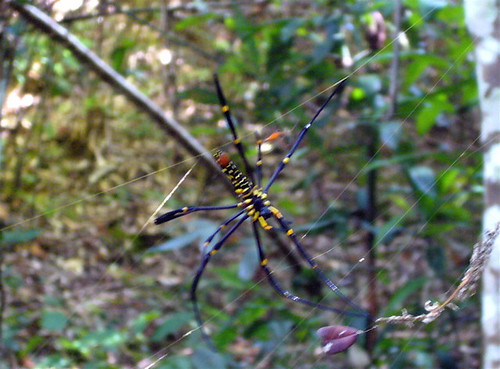
A very large spider...

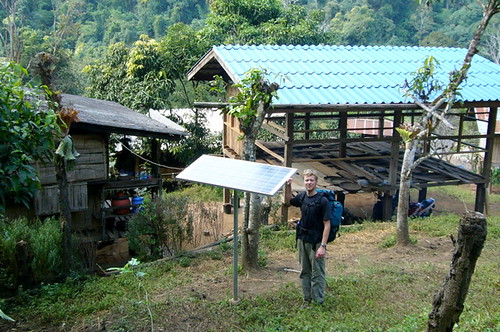
After visiting the geysers we hiked deep into the jungle. Jatoo pointed out all sorts of interesting plants, trees and insects along the way. We arrived in time for dinner at a Karen hill tribe village. The buildings here are made of wood and bamboo, with thatch roofs. Several of the houses had solar cells with batteries and one or two fluorescent bulbs for lighting. These were given to the hill tribes by the government if the tribes promised not to engage in the opium trade.


The hill tribes of northern Thailand are one of the last remaining examples in the world of genuine subsistence living. This particular tribe provides for over 80% of its needs from its small farm and the surrounding jungle. The Karen village we stayed in cannot be reached by car -- only recently have they acquired a motorbike, which mainly the young boys use to go into the tiny town several miles away for socializing.

Many of the tribes in the area are so small – consisting of only a few families – that the government will provide for only one school for several villages. Sometimes the children hike five or ten miles to school, and stay over many nights during the week.
Where we slept at the Karen village. The mosquito nets were unnecessary since it is the dry season. We slept on thin padded mattresses that were quite comfortable, and were awakened (early!) by the roosters.

Although the villages we visited are very “poor” in our sense of the word, the quality of life is not bad, if it is rather hard-scrabble. Diets consist of rice and vegetable as well as meat from chickens, pigs, cows and water buffalos – they thought we were a bit odd for being vegetarian. Also they eat wild rodents like squirrels and field mice, as well as deer and other wild mammals that inhabit the jungles.
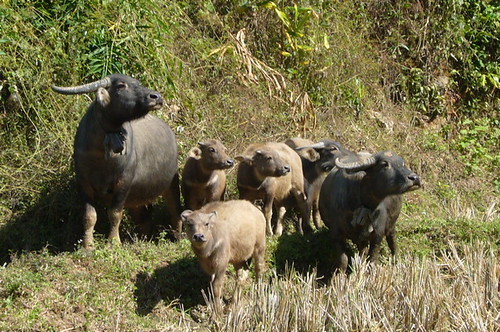
Water buffaloes.

One Karen villager demonstrated an ingenious field mouse trap for me. It was made of a short (about 6 inches long) section of bamboo, which is hollow, with a long piece of stiff reed attached resembling a bow. A loop of twine is concealed in the hollow of the bamboo, and a catch mechanism holds the reed bow in a taut bent position. The trap is loaded with a bit of rice; when the mouse goes to eat the rice it trips the catch and the bow snaps the loop of twine around the mouse’s head and it’s caught. It’s probably hard for you to imagine the device from this description, but I assure you it’s very clever.
Banana trees of several varieties proliferate wildly in the village and surrounding jungle, as well as dragon fruit, mangoes, star-apples and papayas. We saw gardens growing many types of beans, peppers and all sorts of herbs and spices for cooking such as lemon grass and basil.
On the second day we hiked long across two steep mountain ridges and arrived mid-afternoon at an elephant camp along the Mae Taeng river. Our tough hiking through the hot jungle was rewarded with a lazy ride down the river on the back of an elephant to our destination for the evening: a Lahu hill tribe village. No motor vehicles of any kind can reach this village – transportation is only via foot trail or the river. The Lahus have historically been associated with the opium trade from Burma, and so as “punishment” by the government were given no solar cells. They did not seem the worse for it though.


Jatoo says the Lahu are his favorites, since they are so friendly and polite. He mentioned another tribe that has a reputation for being arrogant – the elitists of the hill tribes I suppose. I don’t remember their name, but it’s just as well since I don’t want to be accused libelous speech towards the hill tribes.


Pictured are some young boys playing the Thai national game – takraw – a kind of volleyball using only the feet and head. They are quite good and as such I can’t understand why Thailand is typically so poor at soccer. All villages have takraw courts installed by the government health department as a campaign to promote exercise.

The Lahu children took a real liking to Beth, as you can see here. And I’ve tried to photograph our dinner, but I didn’t do it justice. Jatoo was an excellent cook – even cooking for vegetarians, which he found odd – and the food looked, smelled and tasted superb. We had rice grown in the village paddies, tofu and vegetables in a curry with coconut milk and cashews, as well as an omelete made with fresh green chili paste that Jatoo prepared in a mortar and pestle.

For the final day of the trek we rafted through some mild whitewater rapids on a bamboo raft made by the Lahu villagers. These rafts are about 30 feet long and four feet wide, made of 15 – 20 long thick bamboo poles lashed together with rattan reeds. Near the front of the raft they constructed a tri-pod out of bamboo poles to hold our backpacks up out of the water. As we started down the river, all of the admonitions about standing up in the boat went out the window – there was nowhere to sit and besides we had to stand to use long bamboo poles to guide the raft between rocks and around the many bends of the river.
In the mid-afternoon we reached the pull-out, had lunch, and were picked up by Dtaw and dropped off at his company’s river camp for a snack of coffee, papaya and dragon fruit and to rest a while. His river camp has a few bamboo hut dormitories for overnight treks as well as a kind of cabana hang-out/eating place. It’s all open-air and has a spectacular view of the river below and the rice field and huts of a Thai village along the foothills across the way. It’s basically paradise. We sat in hammocks in the shade and enjoyed the fruit and read Thai travel magazines and conversed for a while. Then Dtaw drove us back to Chiang Mai, with a detour to the Pun Pun farm where I will be living and working this winter.

If Dtaw’s river camp was paradise, then Pun Pun is like some kind of upper level of paradise. I got a brief tour and met some of the folks there. I’m leaving Chiang Mai Saturday December 9 to move up there – as I get settled in I’ll take lots of pictures and try to write some descriptions about how wonderful it is. I’m very excited to share it with you!
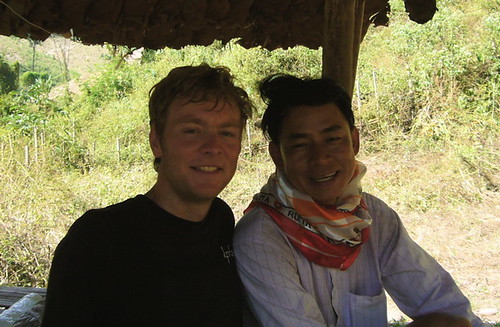
Dtaw introduced us to Jatoo, our guide for the trip. Jatoo is originally from a Karen hill tribe village far in the north of Thailand closer to Chiang Rai and the border with Burma. Jatoo speaks several languages including Thai, English and many of the hill tribe dialects.
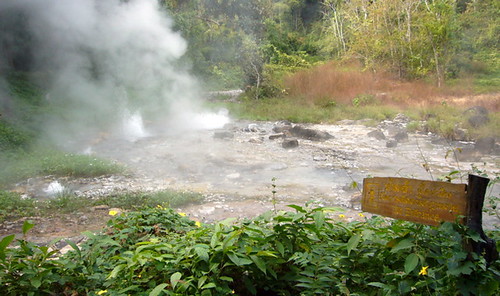
We began the trek at a Thai National Park and wildlife preserve that features a geyser geothermal area. Jatoo had told us that we would start the trek at a hot springs. We left Chiang Mai in the morning and drove for a few hours to begin the hiking around noon. It was getting on to the hottest part of the day and I knew we had many miles of steep climbing ahead through jungle into the mountain provinces, so I was not all that excited to start the trip at a hot springs. A few weeks ago when I was high in the mountains of Idaho and the wind was cold and the sky was pregnant with snow clouds I welcomed the opportunity to soak in hot springs. But in tropical Thailand? A hot spring dip seemed a bit unwelcome.
So you can imagine my surprise, and relief, when I saw jets of boiling water shooting into the air. Of course we wouldn’t be expected to soak in this – when Jatoo had said hot spring he had meant really really hot spring. “Like Yellowstone,” he said. Indeed.
This centipede is nearly 1 foot long, and poisonous.

A termite mound.

A very large spider...
After visiting the geysers we hiked deep into the jungle. Jatoo pointed out all sorts of interesting plants, trees and insects along the way. We arrived in time for dinner at a Karen hill tribe village. The buildings here are made of wood and bamboo, with thatch roofs. Several of the houses had solar cells with batteries and one or two fluorescent bulbs for lighting. These were given to the hill tribes by the government if the tribes promised not to engage in the opium trade.
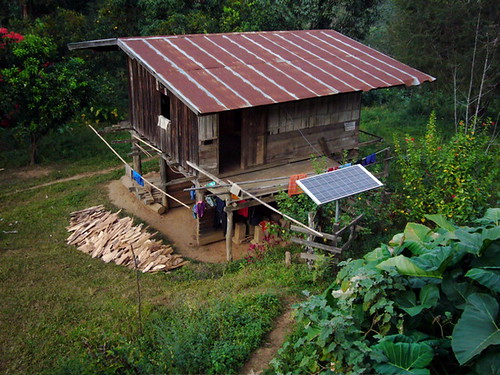
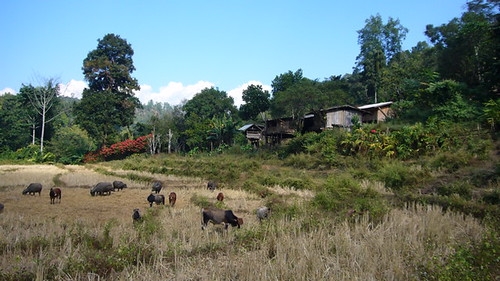
The hill tribes of northern Thailand are one of the last remaining examples in the world of genuine subsistence living. This particular tribe provides for over 80% of its needs from its small farm and the surrounding jungle. The Karen village we stayed in cannot be reached by car -- only recently have they acquired a motorbike, which mainly the young boys use to go into the tiny town several miles away for socializing.
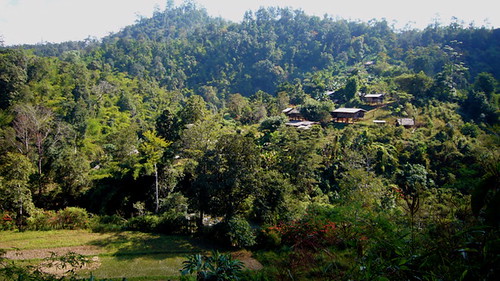
Many of the tribes in the area are so small – consisting of only a few families – that the government will provide for only one school for several villages. Sometimes the children hike five or ten miles to school, and stay over many nights during the week.
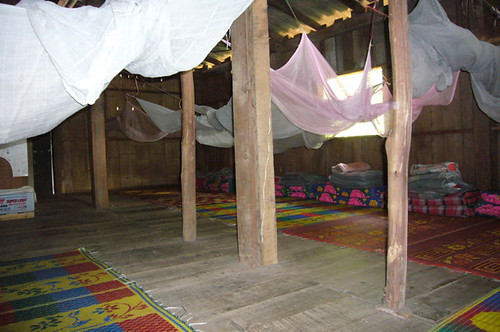
Where we slept at the Karen village. The mosquito nets were unnecessary since it is the dry season. We slept on thin padded mattresses that were quite comfortable, and were awakened (early!) by the roosters.
Although the villages we visited are very “poor” in our sense of the word, the quality of life is not bad, if it is rather hard-scrabble. Diets consist of rice and vegetable as well as meat from chickens, pigs, cows and water buffalos – they thought we were a bit odd for being vegetarian. Also they eat wild rodents like squirrels and field mice, as well as deer and other wild mammals that inhabit the jungles.
Water buffaloes.
One Karen villager demonstrated an ingenious field mouse trap for me. It was made of a short (about 6 inches long) section of bamboo, which is hollow, with a long piece of stiff reed attached resembling a bow. A loop of twine is concealed in the hollow of the bamboo, and a catch mechanism holds the reed bow in a taut bent position. The trap is loaded with a bit of rice; when the mouse goes to eat the rice it trips the catch and the bow snaps the loop of twine around the mouse’s head and it’s caught. It’s probably hard for you to imagine the device from this description, but I assure you it’s very clever.
Banana trees of several varieties proliferate wildly in the village and surrounding jungle, as well as dragon fruit, mangoes, star-apples and papayas. We saw gardens growing many types of beans, peppers and all sorts of herbs and spices for cooking such as lemon grass and basil.
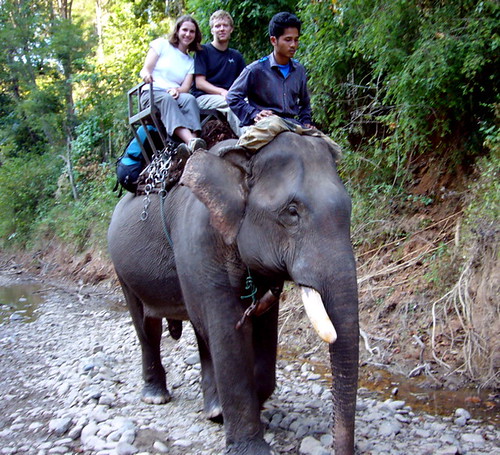
On the second day we hiked long across two steep mountain ridges and arrived mid-afternoon at an elephant camp along the Mae Taeng river. Our tough hiking through the hot jungle was rewarded with a lazy ride down the river on the back of an elephant to our destination for the evening: a Lahu hill tribe village. No motor vehicles of any kind can reach this village – transportation is only via foot trail or the river. The Lahus have historically been associated with the opium trade from Burma, and so as “punishment” by the government were given no solar cells. They did not seem the worse for it though.
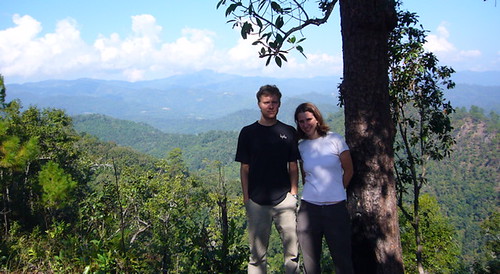
Jatoo says the Lahu are his favorites, since they are so friendly and polite. He mentioned another tribe that has a reputation for being arrogant – the elitists of the hill tribes I suppose. I don’t remember their name, but it’s just as well since I don’t want to be accused libelous speech towards the hill tribes.
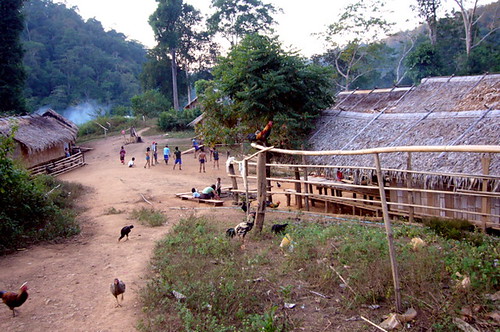
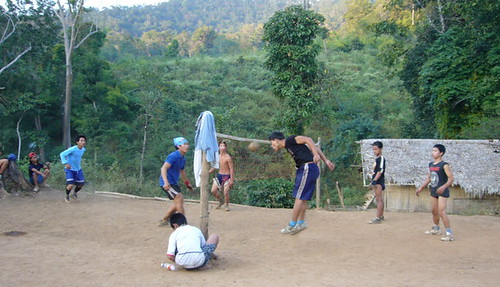
Pictured are some young boys playing the Thai national game – takraw – a kind of volleyball using only the feet and head. They are quite good and as such I can’t understand why Thailand is typically so poor at soccer. All villages have takraw courts installed by the government health department as a campaign to promote exercise.
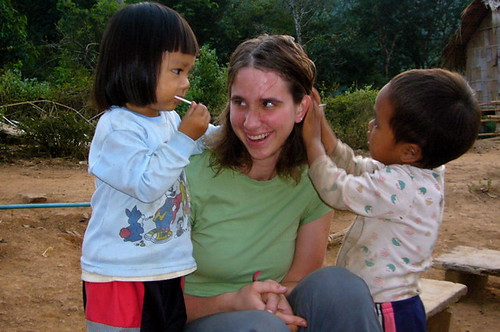
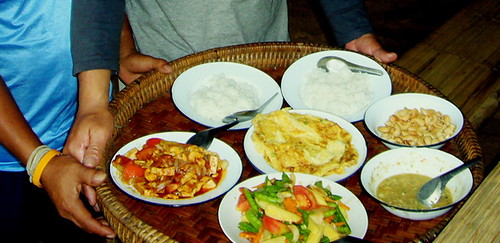
The Lahu children took a real liking to Beth, as you can see here. And I’ve tried to photograph our dinner, but I didn’t do it justice. Jatoo was an excellent cook – even cooking for vegetarians, which he found odd – and the food looked, smelled and tasted superb. We had rice grown in the village paddies, tofu and vegetables in a curry with coconut milk and cashews, as well as an omelete made with fresh green chili paste that Jatoo prepared in a mortar and pestle.
For the final day of the trek we rafted through some mild whitewater rapids on a bamboo raft made by the Lahu villagers. These rafts are about 30 feet long and four feet wide, made of 15 – 20 long thick bamboo poles lashed together with rattan reeds. Near the front of the raft they constructed a tri-pod out of bamboo poles to hold our backpacks up out of the water. As we started down the river, all of the admonitions about standing up in the boat went out the window – there was nowhere to sit and besides we had to stand to use long bamboo poles to guide the raft between rocks and around the many bends of the river.
In the mid-afternoon we reached the pull-out, had lunch, and were picked up by Dtaw and dropped off at his company’s river camp for a snack of coffee, papaya and dragon fruit and to rest a while. His river camp has a few bamboo hut dormitories for overnight treks as well as a kind of cabana hang-out/eating place. It’s all open-air and has a spectacular view of the river below and the rice field and huts of a Thai village along the foothills across the way. It’s basically paradise. We sat in hammocks in the shade and enjoyed the fruit and read Thai travel magazines and conversed for a while. Then Dtaw drove us back to Chiang Mai, with a detour to the Pun Pun farm where I will be living and working this winter.
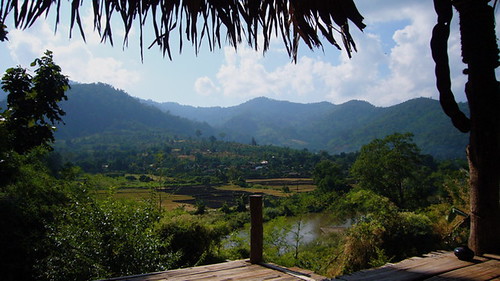
If Dtaw’s river camp was paradise, then Pun Pun is like some kind of upper level of paradise. I got a brief tour and met some of the folks there. I’m leaving Chiang Mai Saturday December 9 to move up there – as I get settled in I’ll take lots of pictures and try to write some descriptions about how wonderful it is. I’m very excited to share it with you!
Arrival in Chiang Mai
Chiang Mai is Thailand’s second largest city, though it is dwarfed by Bangkok (Chiang Mai has about 200,000 inhabitants, as opposed to nearly 8 million in Bangkok). The center of the city is an ancient fort about one square mile in area, complete with some battlements and surrounded by a moat.
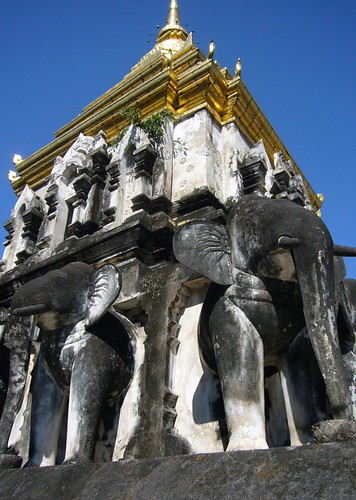
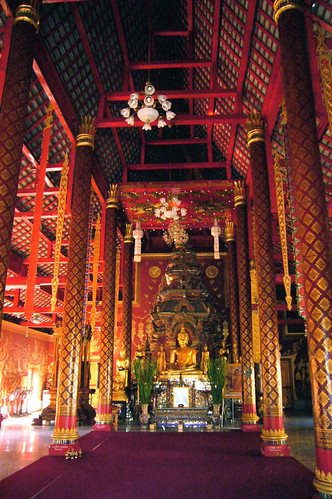
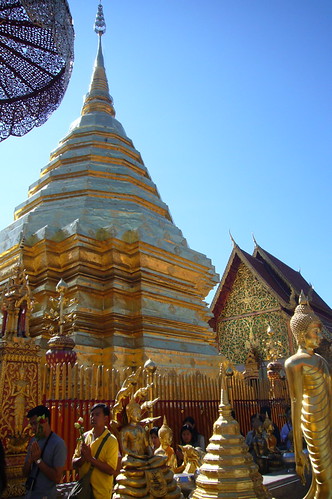
We spent one day walking around this area (called the “old city”) visiting a few of the innumerable wats – Buddhist temples. They are all ornate, beautiful, ancient and fascinating, and all very similar to one another as well and one can only be impressed by elegantly carved teak wood balustrades and golden Buddha imagines for so long.


Chiang Mai is heavily visited by tourists, and this becomes even more apparent as evening sets in and temperatures become cool and pleasant and hordes of Western tourists (some from the U.S. but most from Australia and Europe) roam the streets, restaurants, bars and night markets.
We witnessed several examples of a particular species of Western tourist – the middle-aged Caucasian male accompanied by one or several young Thai girls in the bars and pool halls. These are indicative of one of the more tragic elements of the Thai economy – many of these girls come from very poor villages in the hills of the north and eastern parts of the country. They can make relatively good money to support themselves and their families in the city brothels and thus many willfully, and possibly even enthusiastically, engage in this form of economic and sexual slavery.
I find the psychology of the aged men who hire out these women for sex repugnant as well as fascinating. Witnessing the transactions that occur openly in the bars as the men “shop” for a girl for the evening are eerie and leave one’s conscience feeling somewhat soiled.
As long as I’m discussing things that can put one out of one’s mind, I must also mention the street traffic and the markets.
Traveling the streets by foot or motor vehicle represents the nearest example I can imagine to a chaotic, intensely competitive free-for-all. The main vehicles about are minibuses, a few private cars, delivery trucks, an assortment of types of taxis -- familiar small sedans made by Nissan and Toyota, “song-taos” or pickups with covered beds and two rows of bench seats for passengers, and "tuk tuks" or three-wheeled motorized rickshaws -- and an astounding proliferation of mopeds and small engine motorbikes. Almost all vehicles are diesel or two-stroke gasoline engines, which means (1) noisy and (2) smelly pollution.
There are not so much traffic laws here as traffic suggestions, officially recommending to drive on the left while the practical reality is to drive wherever-and-however-the-fuck-one-pleases. And, apparently, there is no legal limit to how many passengers or what type, size, or amount of goods can be transported by motorbike. I have seen families of three carrying groceries, building materials, bags of laundry, bits of furniture, etc. splitting lanes and dodging delivery trucks on pitifully belabored 90 cc Honda scooters.
This all may seem a recipe for disaster however I have yet to witness a collision. Somehow it all seems to “work” in a chaotic but organic fashion. From the pedestrian’s perspective, crossing the street is reminiscent of the old Atari video game Frogger – you have to pick your spot, set your timing, square your jaw, and proceed across the noisy, dusty, smelly buzzing fray of mopeds and larger vehicles with the “unbending intent” of the warrior described in Castenada’s The Teachings of Don Juan.

And if the continual onslaught of traffic isn’t enough to unravel one’s nervous system, there are the markets. Any time of day or night one can engage in the voracious melee of commerce. The photo above is of one of the lesser day markets and doesn't really give a sense of the pandemonium that these environments conjure up.
All manner of goods are bought and sold in the markets:
from foods – produce, meats and snack foods -- of discernable and unknown origin;
to clothing – t-shirts with every logo and brand image, tailor-made suits, silk and high-fashion goods, as well as an array of cotton hippie clothes (what middle-class Western hippie kids think rural Thai people wear), work clothes, uniforms, pajamas…;
to weapons, ancient as well as modern – long knives, swords, brass knuckles, Beth even saw a stand on the street corner selling handguns (!);
to every possible thing that can be made from bamboo – these products are countless in variety, form and function;
to all manner of knick-knacks, keepsakes, souvenirs, home decorations, Buddha images of all shapes, postures, sizes, and materials from wood and bamboo to stone to brass, gold, silver;
to electronic goods and sports equipment and a thousand other categories of items great and small, cheap and expensive, useful and decorative…
In sum, the markets are a shopper’s paradise and a mild form of torture for me. Wandering the Chiang Mai night market reminds me of the Las Vegas casinos – another environment constructed with the sole purpose of separating the tourist from his or her money.
OK, so far I have discussed the crowding, the noise, the pollution, the sex trade, the chaotic and dangerous street traffic, and those ungodly shrines for worshipping mammon and commerce called “markets.” From this one might assume that life in Thailand is a veritable hell. Well, it’s only sort-of hell. There are aspects that are actually quite nice. It just turns out that the cities and tourist areas lack most of these aspects.
To get a brief respite from the insanity and chaos, one day Beth and I rented an off-road motorbike and headed up towards the summit of Doi Suthep, the large mountain overlooking the city. Near the top we visited a famous and exquisite wat, and continued up to the end of the road where we hiked the nature trail to the summit. In keeping with our earlier experience the nature trail was deserted, although the wat and palace areas just a few kilometers away were sacked with tourists. Here’s a photo of Beth near the summit overlooking a Hmong hill tribe village.

We spent one day walking around this area (called the “old city”) visiting a few of the innumerable wats – Buddhist temples. They are all ornate, beautiful, ancient and fascinating, and all very similar to one another as well and one can only be impressed by elegantly carved teak wood balustrades and golden Buddha imagines for so long.

Chiang Mai is heavily visited by tourists, and this becomes even more apparent as evening sets in and temperatures become cool and pleasant and hordes of Western tourists (some from the U.S. but most from Australia and Europe) roam the streets, restaurants, bars and night markets.
We witnessed several examples of a particular species of Western tourist – the middle-aged Caucasian male accompanied by one or several young Thai girls in the bars and pool halls. These are indicative of one of the more tragic elements of the Thai economy – many of these girls come from very poor villages in the hills of the north and eastern parts of the country. They can make relatively good money to support themselves and their families in the city brothels and thus many willfully, and possibly even enthusiastically, engage in this form of economic and sexual slavery.
I find the psychology of the aged men who hire out these women for sex repugnant as well as fascinating. Witnessing the transactions that occur openly in the bars as the men “shop” for a girl for the evening are eerie and leave one’s conscience feeling somewhat soiled.
As long as I’m discussing things that can put one out of one’s mind, I must also mention the street traffic and the markets.
Traveling the streets by foot or motor vehicle represents the nearest example I can imagine to a chaotic, intensely competitive free-for-all. The main vehicles about are minibuses, a few private cars, delivery trucks, an assortment of types of taxis -- familiar small sedans made by Nissan and Toyota, “song-taos” or pickups with covered beds and two rows of bench seats for passengers, and "tuk tuks" or three-wheeled motorized rickshaws -- and an astounding proliferation of mopeds and small engine motorbikes. Almost all vehicles are diesel or two-stroke gasoline engines, which means (1) noisy and (2) smelly pollution.
There are not so much traffic laws here as traffic suggestions, officially recommending to drive on the left while the practical reality is to drive wherever-and-however-the-fuck-one-pleases. And, apparently, there is no legal limit to how many passengers or what type, size, or amount of goods can be transported by motorbike. I have seen families of three carrying groceries, building materials, bags of laundry, bits of furniture, etc. splitting lanes and dodging delivery trucks on pitifully belabored 90 cc Honda scooters.
This all may seem a recipe for disaster however I have yet to witness a collision. Somehow it all seems to “work” in a chaotic but organic fashion. From the pedestrian’s perspective, crossing the street is reminiscent of the old Atari video game Frogger – you have to pick your spot, set your timing, square your jaw, and proceed across the noisy, dusty, smelly buzzing fray of mopeds and larger vehicles with the “unbending intent” of the warrior described in Castenada’s The Teachings of Don Juan.
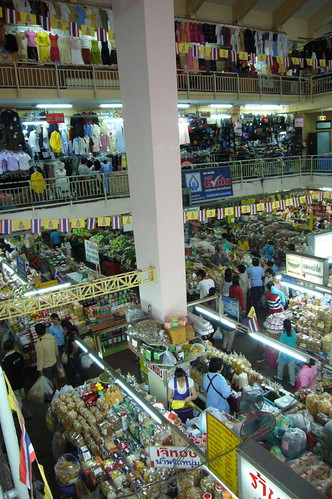
And if the continual onslaught of traffic isn’t enough to unravel one’s nervous system, there are the markets. Any time of day or night one can engage in the voracious melee of commerce. The photo above is of one of the lesser day markets and doesn't really give a sense of the pandemonium that these environments conjure up.
All manner of goods are bought and sold in the markets:
from foods – produce, meats and snack foods -- of discernable and unknown origin;
to clothing – t-shirts with every logo and brand image, tailor-made suits, silk and high-fashion goods, as well as an array of cotton hippie clothes (what middle-class Western hippie kids think rural Thai people wear), work clothes, uniforms, pajamas…;
to weapons, ancient as well as modern – long knives, swords, brass knuckles, Beth even saw a stand on the street corner selling handguns (!);
to every possible thing that can be made from bamboo – these products are countless in variety, form and function;
to all manner of knick-knacks, keepsakes, souvenirs, home decorations, Buddha images of all shapes, postures, sizes, and materials from wood and bamboo to stone to brass, gold, silver;
to electronic goods and sports equipment and a thousand other categories of items great and small, cheap and expensive, useful and decorative…
In sum, the markets are a shopper’s paradise and a mild form of torture for me. Wandering the Chiang Mai night market reminds me of the Las Vegas casinos – another environment constructed with the sole purpose of separating the tourist from his or her money.
OK, so far I have discussed the crowding, the noise, the pollution, the sex trade, the chaotic and dangerous street traffic, and those ungodly shrines for worshipping mammon and commerce called “markets.” From this one might assume that life in Thailand is a veritable hell. Well, it’s only sort-of hell. There are aspects that are actually quite nice. It just turns out that the cities and tourist areas lack most of these aspects.
To get a brief respite from the insanity and chaos, one day Beth and I rented an off-road motorbike and headed up towards the summit of Doi Suthep, the large mountain overlooking the city. Near the top we visited a famous and exquisite wat, and continued up to the end of the road where we hiked the nature trail to the summit. In keeping with our earlier experience the nature trail was deserted, although the wat and palace areas just a few kilometers away were sacked with tourists. Here’s a photo of Beth near the summit overlooking a Hmong hill tribe village.
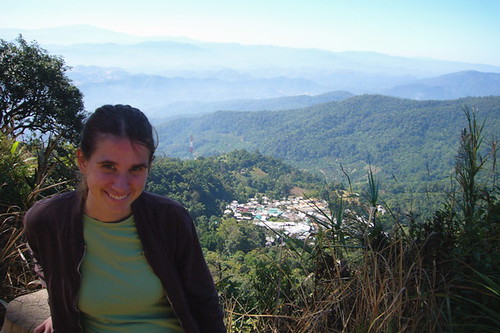
Hello from Thailand!!!
Beth and I arrived in Bangkok mid-afternoon on November 27. We took a cab across the city to the bus station and caught a bus to Kanchanaburi province, about three hours west of Bangkok.
Bangkok is an enormous city, by far the largest in Thailand – about 8 million people. The new Suvarnabhumi airport there replaces Bangkok International and is the largest in Asia, receiving jets that carry up to 550 passengers each. We spent as little time in the city as possible – basically two cab rides back and forth between transportation depots. Bangkok is insanely busy, crowded, noisy, polluted. Maybe some of the tourist areas are nice; I have no desire to ever go back there.
We stayed the night in the provincial hub of Kanchanaburi (city), and the next morning caught a bus to Erawan National park. This steamy tropical mountain-jungle park is known for a series of seven waterfalls and the milky blue water that flows over limestone formations.


We stayed the night in the park in a bamboo house and got up early in the morning to hike along all the falls. The day before the park was like Disneyland with hundreds of Thai and foreign tourists everywhere, crawling over the rocks and swimming in the waterfall pools.

In the early morning before the buses began to arrive we had the whole park to ourselves. We had a refreshing morning swim in the uppermost waterfall pool. A few species of fish live in the pools, and swim up to greet you when you get in the water. They swarm by the dozens and “bite” your legs and arms – it doesn’t hurt but feels kind of weird.

Thai traveling tip #1: Take the nature trails! Even when Erawan Park was crowded with tourists, no one takes the interpretive nature trails. I have no idea why. The trails are so little used that sometimes they just lead off into a patch of bamboo and disappear.

On one of the nature trails we found this strangling fig (ficus) tree. The ficus seeds are deposited in the host tree in bird droppings. Then the fig sends down vine-like roots which eventually strangle the host.
We left Erawan about noon and began the very long journey to Chiang Mai in the north of Thailand. This entailed bus rides from Erawan to Kanchanaburi to the Bangkok bus depot, then the second of our cab rides across the horrendous city (during rush hour!) to the train station. We boarded the train to Chiang Mai about 10 PM, to arrive late the following afternoon.
Sleep came only briefly and fitfully during the night on the train as there were many stops and starts and several attempts to repair our coach’s broken electricity generation system. The morning sun eventually rose to reveal stunning countryside views of expansive rice paddies and quaint villages. Beth and I hung out of the doors of the train as we ascended into the northern mountain provinces. Here the sun was hot but the air drier than the balmy southern regions in and around Bangkok.
Bangkok is an enormous city, by far the largest in Thailand – about 8 million people. The new Suvarnabhumi airport there replaces Bangkok International and is the largest in Asia, receiving jets that carry up to 550 passengers each. We spent as little time in the city as possible – basically two cab rides back and forth between transportation depots. Bangkok is insanely busy, crowded, noisy, polluted. Maybe some of the tourist areas are nice; I have no desire to ever go back there.
We stayed the night in the provincial hub of Kanchanaburi (city), and the next morning caught a bus to Erawan National park. This steamy tropical mountain-jungle park is known for a series of seven waterfalls and the milky blue water that flows over limestone formations.
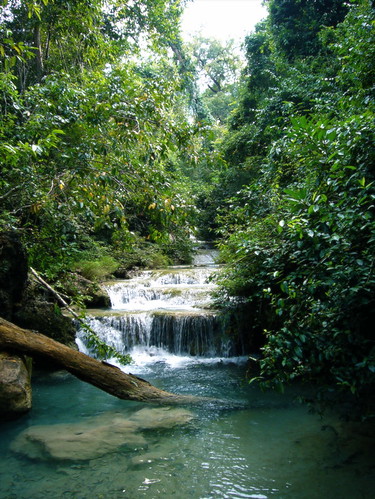


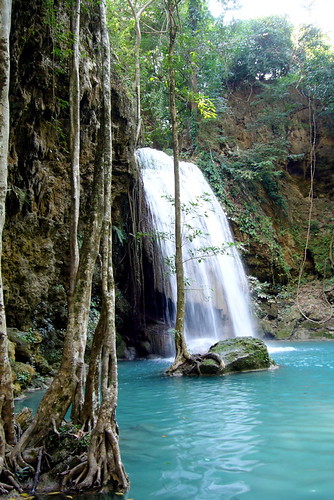
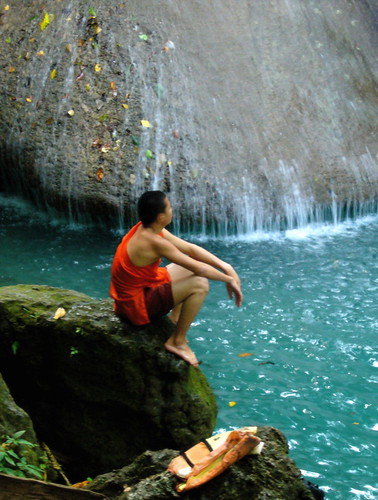
We stayed the night in the park in a bamboo house and got up early in the morning to hike along all the falls. The day before the park was like Disneyland with hundreds of Thai and foreign tourists everywhere, crawling over the rocks and swimming in the waterfall pools.
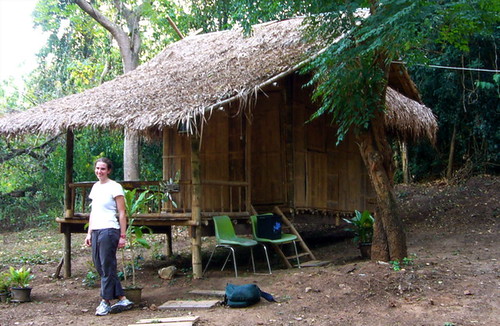
In the early morning before the buses began to arrive we had the whole park to ourselves. We had a refreshing morning swim in the uppermost waterfall pool. A few species of fish live in the pools, and swim up to greet you when you get in the water. They swarm by the dozens and “bite” your legs and arms – it doesn’t hurt but feels kind of weird.
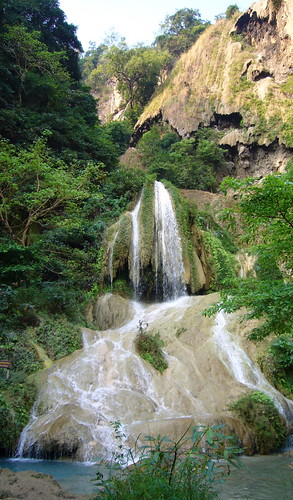
Thai traveling tip #1: Take the nature trails! Even when Erawan Park was crowded with tourists, no one takes the interpretive nature trails. I have no idea why. The trails are so little used that sometimes they just lead off into a patch of bamboo and disappear.
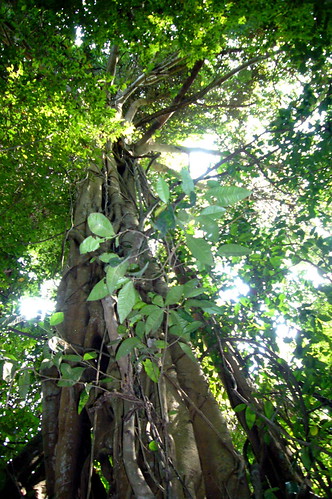
On one of the nature trails we found this strangling fig (ficus) tree. The ficus seeds are deposited in the host tree in bird droppings. Then the fig sends down vine-like roots which eventually strangle the host.
We left Erawan about noon and began the very long journey to Chiang Mai in the north of Thailand. This entailed bus rides from Erawan to Kanchanaburi to the Bangkok bus depot, then the second of our cab rides across the horrendous city (during rush hour!) to the train station. We boarded the train to Chiang Mai about 10 PM, to arrive late the following afternoon.
Sleep came only briefly and fitfully during the night on the train as there were many stops and starts and several attempts to repair our coach’s broken electricity generation system. The morning sun eventually rose to reveal stunning countryside views of expansive rice paddies and quaint villages. Beth and I hung out of the doors of the train as we ascended into the northern mountain provinces. Here the sun was hot but the air drier than the balmy southern regions in and around Bangkok.
Monday, November 20, 2006
Last days in California...
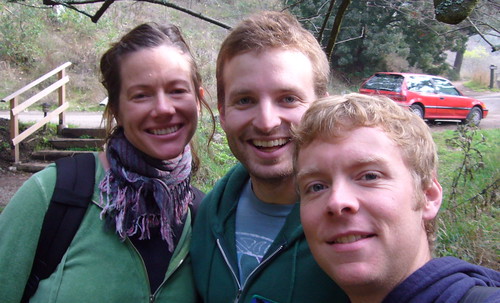
I spent yesterday with my friends Jeff and Melanie at the Green Gulch farm, near Muir Beach in Marin county. We attended the morning meditation and dharma talk at Green Gulch, then explored the farm and hiked around Muir Beach. It's one of my favorite places in the Bay Area -- beautiful, super mellow.
Here's Jeff and Melanie in front of the straw bale garden shed at Green Gulch.
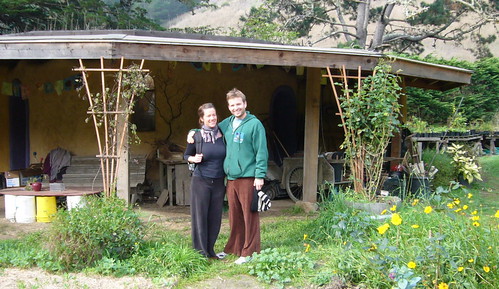
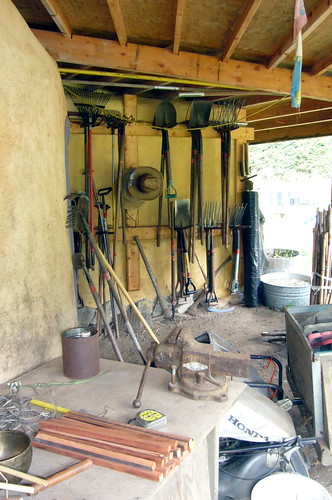
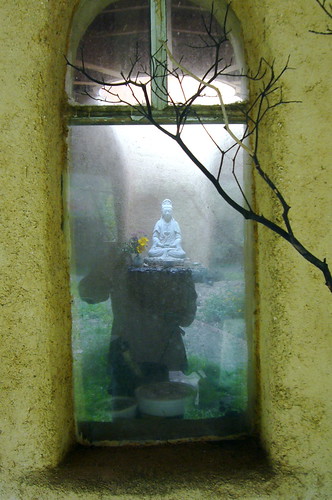
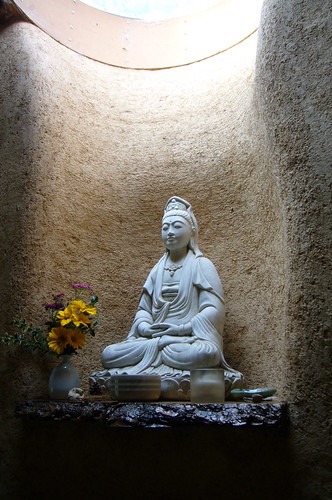
The garden shed is really an amazing structure -- very beautiful, as well as practical. There's hardly a right-angle to be found -- the doors and windows are rounded, the niches are rounded, even the roof is round. It's a welcoming and pleasant design.

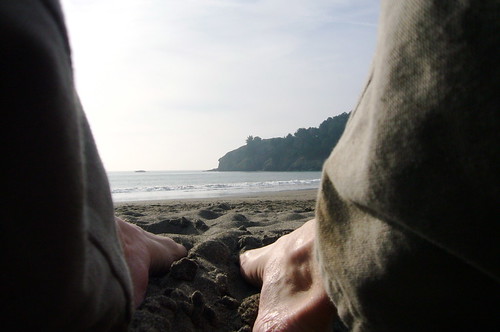
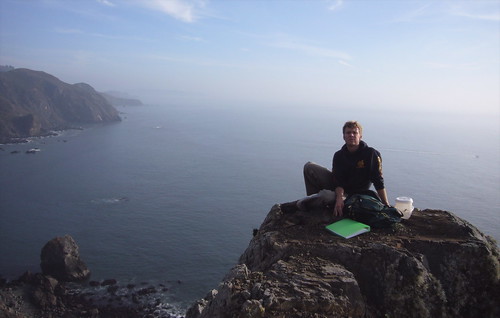
Some shots from Muir beach and the surrounding cliffs...

Saturday, November 04, 2006
Closing the loop
"Closing the loop" is my new terminology for "doing a number-two." The significance is that poo is full of all kinds of great soil-enriching nutrients. So why whoosh it away to the waste treatment plant?
Why indeed. A much more efficient solution is to process it on site and preserve all those wonderful nurtrients to enrich next season's crop of veggies from your garden. Hence "closing the loop," if you will.
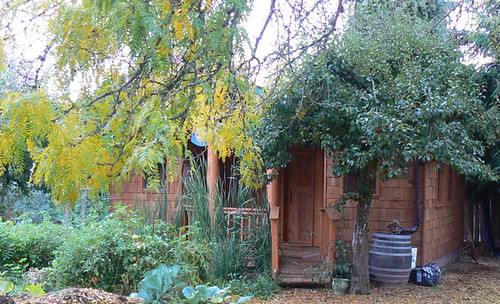
So here's an example of a beautiful and efficient waste processing system that is very pleasant to use. It's at the Dharmalaya Conference Center in Eugene, OR.

Here's the front view, and an interior shot. No, it does not smell bad. It's very pleasant to use.


In this system, the solid and liquid wastes from the toilet and showers are separated. The solid waste is dried (to prevent smell), mixed with sawdust and allowed to compost into dirt. Then it is removed and mixed with compost and used as mulch.
The liquid wastes are pumped out and into a constructed wetlands. The vegetation and microbial action in the wetlands break down the organic materials and produces clean (but non-potable) water which feeds the pond on site and irrigates the gardens.
Why indeed. A much more efficient solution is to process it on site and preserve all those wonderful nurtrients to enrich next season's crop of veggies from your garden. Hence "closing the loop," if you will.
So here's an example of a beautiful and efficient waste processing system that is very pleasant to use. It's at the Dharmalaya Conference Center in Eugene, OR.

Here's the front view, and an interior shot. No, it does not smell bad. It's very pleasant to use.
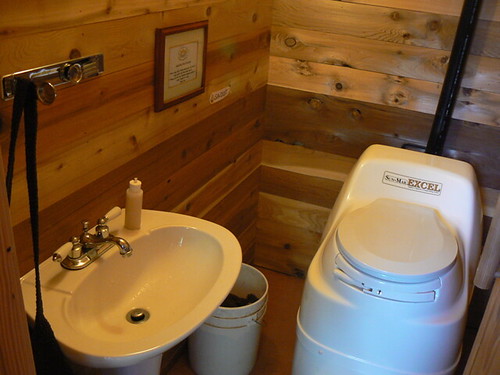
In this system, the solid and liquid wastes from the toilet and showers are separated. The solid waste is dried (to prevent smell), mixed with sawdust and allowed to compost into dirt. Then it is removed and mixed with compost and used as mulch.
The liquid wastes are pumped out and into a constructed wetlands. The vegetation and microbial action in the wetlands break down the organic materials and produces clean (but non-potable) water which feeds the pond on site and irrigates the gardens.
Subscribe to:
Posts (Atom)

